ACCA Syllabus 2026: Complete Breakdown of All 13 Papers

Introduction to ACCA Syllabus

Most “ACCA syllabus” pages give you a list of paper codes and call it a day — BT, MA, FA, and so on, with a one-line description next to each. That’s not actually what you need when you’re sitting down to plan a study year. What you need to know is what each paper actually demands of you: which sections carry the marks, what format you’ll face on exam day, how it connects to the paper before and after it, and where students consistently lose marks. That’s what this guide covers, paper by paper, using the syllabus as it stands for the current 13-paper ACCA Qualification.

One thing worth flagging before you go further: ACCA has confirmed a major restructure of the entire qualification, moving from 13 papers to 11 across four levels, effective July 2027. Everything below reflects the current, live syllabus — the one you’ll actually sit if you’re studying now or starting in the next year or so. We cover exactly what changes under the new structure toward the end of this guide, and importantly, none of your progress under the current syllabus is lost when that transition happens.

The ACCA Syllabus at a Glance

The ACCA Qualification is built from 13 exam papers across three levels — Applied Knowledge, Applied Skills, and Strategic Professional — plus the Ethics and Professional Skills Module (EPSM) and a 36-month Practical Experience Requirement (PER). Here’s the full structure before we go paper by paper.

Level Papers Total Format
Applied Knowledge BT, MA, FA 3 On-demand computer-based exams (CBE), available year-round
Applied Skills LW, PM, TX, FR, AA, FM 6 LW is on-demand, MCQ-based; PM, TX, FR, AA, FM are session-based CBEs (March, June, September, December), mixing objective and written questions
Strategic Professional SBL, SBR (mandatory) + 2 of 4 options: AFM, APM, ATX, AAA 4 Session-based CBEs, entirely scenario-based, no multiple choice

That’s the map. Now let’s walk through what’s actually inside each box.

Applied Knowledge Level: BT, MA, FA

This is the entry level of the syllabus, and it’s designed to build broad awareness before depth. All three papers are two-hour, on-demand computer-based exams, meaning you book a slot at a local centre whenever you’re ready rather than waiting for a fixed sitting. Pass rates here are the highest in the qualification, typically running above 80%, because the format leans heavily on objective testing rather than written analysis.

BT — Business and Technology

BT is the most conceptual of the three Knowledge-level papers — roughly 80% theory, 20% numerical — and it’s where most students get their first real exposure to how a business functions as a whole system, not just as a set of numbers.

Syllabus Section What It Covers
A. The business organisation and its external environment Types and purpose of business organisations, stakeholders, political and legal factors, macro- and micro-economic factors, social and demographic factors, technological factors, environmental and sustainability factors, competitive factors
B. Organisational structure, culture, governance and sustainability Formal and informal structures, organisational culture, corporate governance frameworks, sustainable business practices
C. Business functions, regulation and technology Relationship between accounting and other business functions, the accounting and finance function, regulation and financial crime, financial information, technology and information systems
D. Leading and managing individuals and teams Recruitment, motivation theory, team dynamics, leadership styles, performance appraisal
E. Personal effectiveness and communication Self-management, time management, communication skills
F. Professional ethics in accounting and business Ethical frameworks, the fundamental principles of the ACCA Code of Ethics and Conduct, professional values

BT’s exam format is 100 marks: 45 objective-test questions worth 70 marks in Section A, plus five 6-mark multi-task questions in Section B. If you’re weighing where to start, BT is usually the paper most students sit first, precisely because it gives you the vocabulary — governance, stakeholders, organisational structure — that reappears constantly in every later paper, right up to Strategic Business Leader.

MA — Management Accounting

MA shifts from theory into cost and decision-making numbers. It’s the foundation for two much larger papers later in the syllabus — Performance Management (PM) at Applied Skills, and Advanced Performance Management (APM) at Strategic Professional — so gaps here compound.

Key topics covered: the nature and purpose of cost and management accounting, cost classification and behaviour, marginal and absorption costing, job, batch and process costing, budgeting and forecasting techniques, standard costing and variance analysis, and performance measurement using both financial and simple non-financial indicators.

If there’s one habit that separates strong MA candidates from struggling ones, it’s this: MA rewards mechanical accuracy under time pressure far more than conceptual insight. Practising calculation-heavy questions repeatedly, at exam speed, matters more here than it will in almost any other paper in the qualification.

FA — Financial Accounting

FA is where double-entry bookkeeping actually gets built from the ground up — the skill every later financial paper in the syllabus assumes you already have solid.

Key topics covered: the context and purpose of financial reporting, the qualitative characteristics of financial information, double-entry bookkeeping and the accounting equation, recording transactions and events (including accruals, prepayments, depreciation, inventory valuation, and irrecoverable debts), preparing trial balances, correcting errors, bank reconciliations, and preparing basic financial statements for sole traders and simple companies, including an introduction to consolidated accounts.

FA is graded 100% objective test — multiple choice, multiple response, and number-entry questions — but don’t mistake that for “easy.” The volume of adjustments tested in a single question (a trial balance with five or six simultaneous corrections, for example) is where most marks are actually lost.

ACCA in Nepal

Applied Skills Level: LW, PM, TX, FR, AA, FM

This is the bridge between foundational knowledge and professional judgement. Five of the six papers move to a fixed quarterly sitting (March, June, September, December); the sixth — LW — stays on-demand, which is a detail worth knowing because it changes how you sequence your study year.

Code Paper Name Format Session
LW Corporate and Business Law 2 hours, 100% objective test (45 questions + 5 multi-task questions) On-demand, year-round
PM Performance Management 3 hours, objective test + constructed response Quarterly (Mar/Jun/Sep/Dec)
TX Taxation 3 hours, objective test + constructed response Quarterly
FR Financial Reporting 3 hours, objective test + constructed response Quarterly
AA Audit and Assurance 3 hours, objective test + constructed response Quarterly
FM Financial Management 3 hours, objective test + constructed response Quarterly

LW — Corporate and Business Law

LW is the only entirely non-numerical paper in the whole qualification, and the only Applied Skills paper you can book on-demand rather than waiting for a quarterly window — a genuinely useful piece of scheduling flexibility if you want to slot a paper into a quieter month.

Key syllabus areas: the essential elements of the legal system, the law of obligations (contract and tort), employment law, the formation and constitution of business organisations, capital and financing of companies, management, administration and regulation of companies, legal implications of company insolvency, corporate fraud and criminal behaviour.

You’ll choose a variant — LW-ENG (English law) is the most widely sat globally, LW-GLO (Global) covers general principles including the UN Convention on Contracts for the International Sale of Goods, and several country-specific variants exist for jurisdictions such as Ireland, Malaysia, and Singapore. There’s no dedicated Nepal variant, so most Nepali candidates sit either LW-ENG or LW-GLO — check with your tuition provider which one aligns better with the career market you’re targeting.

Note for anyone reading this close to the 2027 changeover: LW is scheduled to move down into the new Knowledge level as “K3 Business Law” from July 2027, with a revised all-objective-test format. A pass in the current LW earns automatic credit under the new structure either way.

PM — Performance Management

PM builds directly on MA and is widely regarded as one of the harder Applied Skills papers, with pass rates typically sitting in the 40–45% range.

Key syllabus areas: management accounting information systems and big data, specialist cost and management accounting techniques (activity-based costing, target costing, throughput accounting, life-cycle costing), decision-making techniques (relevant costing, limiting factor analysis, pricing decisions, decision trees), budgeting (including beyond-budgeting and rolling budgets), standard costing and variance analysis (including more complex mix and yield variances), and performance measurement and control (divisional performance, transfer pricing, non-financial performance indicators, and the balanced scorecard).

The step up from MA is real: PM expects you to apply techniques to messy, scenario-based situations rather than compute a formula in isolation. Most tutors recommend PM early in the Applied Skills sequence, alongside or shortly after LW, precisely because its content underpins Advanced Performance Management (APM) much later.

TX — Taxation

TX covers the tax system relevant to individuals and businesses, and — like LW — is offered in country-specific variants, since tax law is inherently jurisdiction-bound. There’s no Nepal-specific TX variant, so most Nepali and South Asian candidates sit the UK variant (TX-UK) unless their tuition provider offers a different regional option.

Key syllabus areas: the overall function and purpose of taxation in a modern economy, income tax liabilities for individuals, employment income, National Insurance contributions (for the UK variant), corporation tax liabilities, chargeable gains, and an introduction to value added tax (VAT).

TX tests both computational accuracy and the ability to explain tax treatment in writing, which is why students who come from a purely numerical background sometimes find the written-explanation component harder to score well on than the calculations themselves.

FR — Financial Reporting

FR is the direct successor to FA, and it’s widely considered one of the hardest Applied Skills papers, with pass rates typically in the high 40s.

Section Marks What It Tests
Section A 30 Objective-test questions on basic concepts and IFRS knowledge
Section B 30 Scenario-based multiple-choice questions testing application of accounting rules
Section C 40 Long-form questions requiring preparation and analysis of financial statements

Key syllabus areas: the conceptual and regulatory framework for financial reporting, accounting for transactions under specific IFRS standards (Property, Plant and Equipment under IAS 16; Intangible Assets under IAS 38; Inventory under IAS 2; Revenue under IFRS 15; Leases under IFRS 16; Financial Instruments under IFRS 9; Provisions and Contingencies under IAS 37), preparation of financial statements for single entities and simple groups, and analysis and interpretation of financial statements, including ratio analysis.

FR’s Section C is where most marks are won or lost — full financial statement preparation questions demand speed and accuracy under real time pressure. Studying FR thoroughly before attempting AA is one of the most consistently recommended sequencing decisions in the whole qualification, since you can’t meaningfully audit a set of financial statements you don’t yet know how to prepare.

AA — Audit and Assurance

AA builds directly on FR and is where the syllabus shifts from “can you produce financial statements” to “can you challenge and verify them.”

The syllabus is organised into six parts:

  • Part A — Audit framework and regulation: the concept of audit and assurance engagements, external audits, corporate governance, professional ethics
  • Part B — Planning and risk assessment: obtaining and accepting engagements, assessing audit risk, understanding the entity and its environment, fraud, laws and regulations, audit planning and documentation
  • Part C — Internal control: internal control systems, evaluating and testing controls, communicating deficiencies
  • Part D — Audit evidence: assertions and evidence, audit procedures, sampling, auditing specific financial statement items, automated audit tools and techniques, the work of others
  • Part E — Reporting and review: subsequent events, going concern, written representations, audit finalisation and final review, the independent auditor’s report
  • Part F — Employability and technology skills: navigating digital exam tools, presenting audit conclusions clearly

Internal controls and professional ethics are two of the most heavily and consistently tested areas, so if you’re prioritising revision time, those two sections repay the investment more reliably than most others.

FM — Financial Management

FM is the final Applied Skills paper, and it prepares you for decisions a Chief Financial Officer actually makes day to day: what to invest in, how to fund it, and how to manage the cash in between.

Section Topic
A Financial management function
B Financial management environment
C Working capital management
D Investment appraisal
E Business finance
F Business valuations
G Risk management
H Employability and technology skills

The exam is three hours, split into Section A (15 objective-test questions, 30 marks), Section B (three scenario-based questions, 30 marks), and Section C (two constructed-response questions requiring both calculation and written analysis, 40 marks). The highest-priority topics, based on how consistently they’re examined, are investment appraisal (NPV, IRR, payback), cost of capital (WACC), and working capital management — master those three and you’ve covered a large share of the available marks. FM leads directly into Advanced Financial Management (AFM) at Strategic Professional, so it’s worth treating as more than just “another paper to clear.”

Strategic Professional Level: SBL, SBR, and the Options

This is the final stretch, and it’s a genuinely different kind of exam from everything before it. There are no multiple-choice questions anywhere in Strategic Professional — every paper is entirely scenario-based, testing whether you can apply everything you’ve learned so far the way a senior finance professional actually would, under realistic time and information constraints.

Code Paper Type Duration
SBL Strategic Business Leader Mandatory 4 hours
SBR Strategic Business Reporting Mandatory 3 hours 15 minutes
AFM Advanced Financial Management Option (choose 2 of 4) 3 hours 15 minutes
APM Advanced Performance Management Option 3 hours 15 minutes
ATX Advanced Taxation Option 3 hours 15 minutes
AAA Advanced Audit and Assurance Option 3 hours 15 minutes

SBL — Strategic Business Leader

SBL is unlike any other paper in the syllabus: it’s built around a single, integrated case study, with 14–15 pages of pre-seen material about a fictional company released two weeks before the exam. On exam day, you’re given additional exhibits and asked to respond as a senior finance professional advising that business — weighing strategy, risk, governance, ethics, and technology together, rather than in isolated silos.

Key areas covered: leadership, governance, strategy formulation and implementation, risk management, technology and data analytics, organisational control and audit, finance and financial reporting in a strategic context, and professional skills including communication and ethical judgement, which together account for 20 of the paper’s marks alongside 80 technical marks.

Because SBL demands you draw on almost everything from earlier papers simultaneously — costing from MA and PM, reporting from FR, governance from BT — most students find it easier to sit after they’ve already cleared at least a few Applied Skills papers thoroughly, not as an isolated final hurdle.

SBR — Strategic Business Reporting

SBR is the natural continuation of FR, pushed to a genuinely advanced level.

Key areas covered: the professional and ethical duty of the accountant, the financial reporting framework, reporting the financial performance of entities including complex groups (subsidiaries, associates, joint arrangements), financial instruments, share-based payment, employee benefits, and current issues in corporate reporting, including sustainability and integrated reporting, which have grown considerably in weighting in recent syllabus updates.

SBR tests both technical accuracy and the ability to justify a treatment in writing when the “correct” answer genuinely depends on judgement — which is a different skill from FR’s more mechanical statement preparation, and one that surprises candidates who assume SBR is simply “FR again, but longer.”

The Four Strategic Options — Choose Any 2

Every candidate picks exactly two of these four, based on the career direction they’re aiming for.

  • AFM — Advanced Financial Management: advanced investment appraisal under uncertainty, treasury and advanced risk management, business valuations, mergers and acquisitions, and international corporate finance. The natural progression from FM, and generally the strongest choice for anyone aiming at treasury, corporate finance, or investment banking-adjacent roles.
  • APM — Advanced Performance Management: strategic performance measurement systems, the role of information technology and data analytics in performance management, change management, and evaluating organisational performance in complex, often multinational, environments. The direct continuation of PM and MA, and consistently one of the hardest papers in the qualification, with pass rates that regularly sit lowest across the whole syllabus.
  • ATX — Advanced Taxation: advanced tax planning and advisory work for individuals, companies, and groups, international tax considerations, and the ethical boundary between legitimate tax planning and tax avoidance or evasion. The natural next step from TX, and the clearest route for anyone aiming specifically at a tax advisory career.
  • AAA — Advanced Audit and Assurance: the regulatory environment, professional and ethical considerations under the IESBA Code of Ethics, quality management under ISQM 1 and 2, planning and conducting audits of complex and group entities, evaluating audit evidence and risk of material misstatement, audit reporting including modified opinions, and other assignments such as due diligence, forensic auditing, and — increasingly — sustainability assurance engagements. AAA typically has the lowest pass rate of the four options, often in the high-30s to low-40s percentage range, and rewards candidates who can consistently link identified risks to specific financial statement assertions rather than describing them generically.

Most students choose their two options based on career direction rather than perceived difficulty: AFM and ATX suit finance and tax specialisation, while APM and AAA suit candidates heading toward strategy, performance, or audit leadership roles. If you’re undecided, it’s worth choosing the option that overlaps most with your current or intended job function — the case-study material lands far more intuitively when you’ve already seen a version of the problem at work.

What is ACCA - And Why It Could Transform Your Finance Career

The Ethics and Professional Skills Module (EPSM)

Separate from the 13 exam papers, ACCA requires every candidate to complete the Ethics and Professional Skills Module before attempting Strategic Professional exams. It’s an online, self-paced module rather than a written exam, covering ethical frameworks, professional scepticism, and workplace skills such as communication, analysis, and commercial acumen.

It’s easy to treat EPSM as a formality precisely because it isn’t graded like a traditional exam — but that’s a mistake. The professional judgement and structured-communication skills it builds are directly tested in SBL, and candidates who complete EPSM properly, rather than skimming it, consistently find the transition into Strategic Professional smoother.

Why the Syllabus Keeps Changing

If you’ve studied ACCA material from even two or three years ago alongside a current study guide, you’ve probably noticed the content isn’t identical. ACCA reviews and updates its syllabuses on a rolling annual cycle, not just at major structural moments like the 2027 redesign. Most years, the changes are incremental — a new IFRS standard added to FR or SBR, more explicit coverage of data analytics and automated audit tools in AA and AAA, expanded sustainability and ESG content across FR, SBR, and AAA, and small adjustments to weighting as certain topics prove more or less relevant to how the profession actually works.

This matters practically in one specific way: study materials go out of date faster than most students expect. A study text or question bank written for an exam sitting two or three years ago may be missing a standard, a weighting shift, or an entire sub-topic that’s since been added — sustainability assurance in AAA is a good recent example, since it barely featured in older editions and now appears regularly. Always confirm you’re studying from materials aligned to the current examinable documents for your specific sitting, not just “the latest edition available,” since editions can lag behind ACCA’s own update calendar by a few months.

Common Syllabus-Level Mistakes Students Make

A few patterns show up repeatedly among candidates who struggle more than their ability level would suggest, and most of them are about how the syllabus is approached rather than raw difficulty:

  • Treating each paper as a closed box. Because papers are examined separately, it’s tempting to study them separately too — cramming MA, passing it, and mentally filing it away before PM. But PM assumes fluent recall of MA’s costing techniques, and APM assumes the same of PM. Papers that feed into later ones are worth periodically revisiting even after you’ve passed them, not just banking the pass and moving on.
  • Under-preparing for the shift from objective to written testing. Applied Knowledge is almost entirely machine-marked multiple choice. By the middle of Applied Skills, and especially at Strategic Professional, a large share of marks depend on how clearly and completely you write a professional judgement in a limited time. Candidates who don’t deliberately practise timed written answers — not just reading model answers — consistently underperform relative to their technical knowledge.
  • Skipping the “employability and technology skills” sections. Nearly every recent paper includes a smaller syllabus area covering digital exam tools, presenting information clearly, and using spreadsheet or word-processing functionality within the exam software itself. It’s easy to assume this doesn’t need dedicated preparation — but losing marks to unfamiliarity with the exam interface, rather than the accounting content, is a genuinely avoidable failure mode, and a quick run-through of ACCA’s official practice platform before exam day closes that gap entirely.
  • Choosing Strategic Professional options based on perceived ease rather than career fit. APM and AAA have lower pass rates than AFM and ATX on average, which tempts some students to avoid them regardless of relevance. But an option that connects to work you’re already doing, or clearly want to move into, is consistently easier to study for than one chosen purely because its headline pass-rate statistic looks friendlier — the case-study material simply makes more intuitive sense when you’ve seen a version of the problem in a real job.

How the ACCA Syllabus Connects: A Study Sequence That Actually Works

The 13 papers aren’t a random list — they’re built to layer on top of each other, and sitting them out of order is one of the most common, avoidable reasons capable candidates struggle with a paper that earlier material would have made easier.

A sequence most experienced tutors recommend:

  1. BT → MA → FA (Applied Knowledge, 6–12 months) — build broad awareness and the accounting fundamentals everything else depends on.
  2. LW, early and in parallel — since it’s on-demand, there’s no reason to hold it back; many students sit it alongside their last Applied Knowledge paper.
  3. PM → FM → FR → AA → TX (Applied Skills, 12–24 months) — FR before AA specifically, because auditing financial statements you don’t yet know how to prepare is significantly harder than it needs to be.
  4. EPSM, completed during this phase, not saved for the end.
  5. SBL and SBR, followed by your two chosen options (Strategic Professional, 12–18 months).

Throughout, your 36-month Practical Experience Requirement should be running concurrently with your exams, not started only after your final paper — waiting adds unnecessary time to your total qualification journey.

Pass Rates Across the ACCA Syllabus, at a Glance

Pass rates shift slightly between sittings and are published by ACCA after each exam session, so treat the figures below as directional rather than fixed — but the overall pattern holds consistently across recent years.

Level Typical Pass Rate Range Note
Applied Knowledge (BT, MA, FA) 65–85% Objective-test heavy; rewards accuracy and speed
LW 75–82% Highest pass rate in Applied Skills; purely objective
PM, TX, FM 40–56% Mixed objective and written; application-heavy
FR, AA 42–51% Among the hardest Applied Skills papers
SBL, SBR 48–53% Scenario-based, professional-skills marks included
AFM, ATX 44–53% Specialist options, strong link to FM/TX respectively
APM, AAA 38–46% Consistently the two hardest papers in the qualification

The trend to plan around: papers don’t just get longer as you progress — they shift from testing whether you know the rule to testing whether you can apply professional judgement under time pressure. Studying for Strategic Professional the same way you studied for Applied Knowledge is one of the most common reasons otherwise capable candidates stumble late in the qualification.

What Changes in the ACCA Syllabus From 2027

Since this guide is specifically about the syllabus, it’s worth being precise about what’s actually changing under the confirmed 2027 redesign, rather than leaving it vague.

From July 2027, the qualification moves from 13 papers across 3 levels to 11 papers across 4 levels: Foundations, Knowledge, Expertise, and Strategic Professional.

Current Paper What Happens Under the New Structure
BT Retired as a standalone paper; content absorbed into other modules
MA Becomes K2 — Management Accounting, at Knowledge level
FA Becomes K1 — Financial Accounting, at Knowledge level
LW Moves down to become K3 — Business Law, at Knowledge level, with a revised all-objective-test format
PM, TX, FR, AA, FM Reorganised into the new five-paper Expertise level (renamed from Applied Skills)
EPSM (single module) Replaced by three separate, assessed Essential Employability Modules — one per level
SBL, SBR + 2 options Strategic Professional keeps SBL and SBR, but drops from two optional papers to one, with a new Data Science Professional (SDS) option added

If you’re already partway through the current syllabus, or starting now, none of this should change your plans: every exam passed under the current 13-paper structure carries forward automatically into the new system through ACCA’s official Transition Tool, with no resits required. The practical guidance echoed across the profession is consistent — there’s no advantage to waiting for the new syllabus before you start; the papers you pass today count either way.

Final Word: Studying the ACCA Syllabus, Not Just Memorising It

The single biggest shift in how to approach the ACCA syllabus, from Applied Knowledge through to Strategic Professional, is this: early papers reward knowing the content; later papers reward applying it under realistic pressure, in writing, with limited time.

Past exam questions attempted under full timed conditions consistently outperform passive review as a study method, especially from FR onward — and understanding how each paper feeds into the next, rather than treating all 13 as thirteen disconnected hurdles, is what actually shortens your route to full ACCA membership.

ACCA at FinT

Frequently Asked Questions About the ACCA Syllabus

1. How many papers are in the current ACCA syllabus? 13 papers across three levels: Applied Knowledge (BT, MA, FA), Applied Skills (LW, PM, TX, FR, AA, FM), and Strategic Professional (SBL, SBR, plus two options from AFM, APM, ATX, AAA).

2. Which ACCA paper is hardest? Based on consistently published pass rates, Advanced Performance Management (APM) and Advanced Audit and Assurance (AAA) are typically the two hardest, often with pass rates in the high-30s to mid-40s percentage range.

3. Which ACCA paper has the highest pass rate? Corporate and Business Law (LW), often above 75–80%, largely because it’s a purely objective-test paper with no written-scenario component.

4. What order should I sit the ACCA papers in? A common recommended sequence is BT → MA → FA, then LW early (it’s on-demand), followed by PM → FM → FR → AA → TX, then SBL and SBR, followed by your two chosen options.

5. Is the ACCA syllabus the same worldwide? Mostly, yes — the technical content is standardised globally. The exception is papers with country-specific variants, namely LW (law) and TX (tax), since legal and tax systems differ by jurisdiction.

6. Which two optional papers should I choose at Strategic Professional? It depends on career direction: AFM suits corporate finance and treasury, APM suits strategy and performance roles, ATX suits tax advisory, and AAA suits audit leadership. Most candidates choose based on the function they already work in or want to move into.

7. Do I need to complete papers in order? Not strictly, though ACCA recommends Applied Knowledge before Applied Skills before Strategic Professional, and studying FR before AA specifically, since auditing depends on understanding financial statement preparation first.

8. What is the Ethics and Professional Skills Module, and when do I take it? An online, non-exam module covering ethical judgement and professional skills, required before attempting Strategic Professional papers. Most students complete it alongside their later Applied Skills papers rather than as a separate final step.

9. Are ACCA exams all computer-based now? Yes — there are no remaining pen-and-paper sittings in the current ACCA Qualification; all 13 papers are delivered as computer-based exams, either on-demand or in fixed quarterly sessions.

10. How many marks do I need to pass an ACCA paper? 50 out of 100 marks (50%) is the standard pass mark across all 13 papers.

11. What’s the difference between objective-test and constructed-response questions? Objective-test questions (multiple choice, multiple response, fill-in-the-blank) are auto-marked and test recall and application at speed. Constructed-response questions require written or calculated answers and test deeper analysis, judgement, and communication — these appear increasingly from Applied Skills onward.

12. Does the ACCA syllabus cover sustainability and ESG? Yes, and increasingly so — sustainability and integrated reporting content has expanded within Financial Reporting (FR), Strategic Business Reporting (SBR), and Advanced Audit and Assurance (AAA) in recent syllabus updates, and the 2027 redesign builds this in even further.

13. Is the ACCA syllabus changing in 2026? The core 13-paper structure remains the same for exams sat during 2026; ACCA makes incremental content updates most years (such as expanded sustainability and technology coverage), but the major structural change to 11 papers doesn’t take effect until July 2027.

14. Will I lose my progress when the syllabus changes in 2027? No. Every exam passed under the current structure carries forward automatically into the new 11-paper system via ACCA’s official Transition Tool, with no resits needed.

15. How long does it typically take to get through the whole syllabus? Around 3–4 years for a candidate with no exemptions, sitting exams across the quarterly and on-demand windows while working. Candidates with exemptions from a relevant degree can finish considerably faster.

16. Which ACCA papers can I get exemptions for? Exemptions are generally available across Applied Knowledge and Applied Skills, based on recognised prior qualifications such as a relevant bachelor’s degree. Strategic Professional papers can never be exempted, regardless of prior qualification.

17. Is the ACCA syllabus mostly mathematics? No. Applied Knowledge and several Applied Skills papers (MA, FM, PM in particular) are numerically focused, but the syllabus overall blends calculation with written analysis, legal and ethical reasoning, and strategic judgement — advanced mathematics like calculus is not required anywhere in the qualification.

What is ACCA? And Why It Could Transform Your Finance Career

Introduction on What is ACCA

There’s a specific kind of stuck that finance graduates and working accountants know well. You’ve got the degree, maybe a few years in a firm, and a decent grip on debits and credits — but nobody outside your own office quite recognises what that means. You watch classmates apply for jobs in Dubai, London, or Sydney and get filtered out at the first screening, not because they lack skill, but because their qualification doesn’t translate. That’s the gap ACCA was built to close.

If you’ve typed “what is ACCA” into Google, you’ve probably already skimmed three or four articles that all say roughly the same thing: a UK-based body, 13 papers, recognised in 180-plus countries. True, but thin. It doesn’t tell you what the qualification actually changes about your career, what the next two years of your life will look like while you study for it, or — critically — that ACCA itself is in the middle of the biggest structural overhaul it has made in over a decade. This guide covers all of that, with the numbers, the timelines, and the honest trade-offs, including what it looks like to pursue ACCA from Kathmandu specifically.

What Is ACCA, Exactly?

ACCA stands for the Association of Chartered Certified Accountants, a professional accounting body headquartered in the United Kingdom. Founded in 1904, it has grown into one of the largest global accountancy institutes, with more than 250,000 members and over 500,000 students studying across 180-plus countries.

But ACCA isn’t just the organisation — in everyday conversation, “ACCA” also refers to the qualification itself: a structured programme of professional exams, an ethics module, and supervised work experience that, once completed, entitles you to call yourself an ACCA-qualified accountant and use the letters after your name.

Unlike a country-specific accounting credential, ACCA is built on International Financial Reporting Standards (IFRS) and international auditing standards, which is precisely why it travels. A finance manager who qualified in Kathmandu can walk into a multinational’s Dubai office, a UK audit firm, or a Singapore bank, and the qualification means the same thing everywhere. That portability is the entire point of the credential, and it’s the single biggest reason it has grown so quickly across South Asia, the Middle East, and East Africa over the past fifteen years.

In some jurisdictions, a completed ACCA is formally recognised as equivalent to a master’s-level qualification in accounting and finance — which is part of why universities and employers increasingly treat it as more than “just a professional course.”

Why ACCA Could Genuinely Change the Trajectory of Your Career

Here’s the part most guides skip: ACCA doesn’t just add a line to your CV. It restructures what kind of finance career is available to you in three specific ways.

  • It removes the geography problem. A local accounting qualification ties your credibility to one country’s regulatory system. ACCA doesn’t. If you’re a Nepali student who wants to eventually work in Kathmandu, Kuala Lumpur, or Kuwait, without repeating your qualification from scratch each time, ACCA is one of the only realistic paths that gets you there.
  • It compounds with what you already have. Because ACCA grants exemptions for relevant prior study — a bachelor’s in commerce, an ICAN or CA-Inter background, an MBA in finance — it rarely means starting from zero. Most Nepali graduates entering with a B.Com or BBA background are exempted from several papers, which shortens both the timeline and the cost.
  • It’s designed to be done alongside work. Unlike a full-time postgraduate degree, ACCA’s computer-based exams run on a flexible, on-demand and quarterly sitting structure, so most candidates study while employed — which means you’re building the Practical Experience Requirement and your salary history at the same time you’re building the qualification.

None of that means it’s easy. It’s a genuinely demanding programme, and the honest picture — costs, pass rates, and the study hours required — is covered further down. But for the right candidate, it’s one of the few qualifications that changes not just your resume, but your entire radius of opportunity.

Who ACCA Is a Poor Fit For

Most guides only sell the upside, so it’s worth being equally direct about who shouldn’t rush into this qualification.

If you want a fast, low-cost entry into a finance job and don’t care about international mobility, a shorter local diploma or a direct entry-level accounting role might get you employed faster and cheaper. ACCA is a multi-year commitment, and treating it as a quick credential to pad a CV usually ends in half-finished papers and sunk tuition.

If you strongly dislike self-directed, exam-heavy study, the format will frustrate you. Unlike a lecture-based degree with continuous assessment, ACCA is fundamentally exam-driven: you study a syllabus, sit a computer-based exam on a fixed date, and either pass or resit. There’s no partial credit for effort.

And if your career goal is specifically to practise as a statutory auditor within Nepal’s domestic regulatory framework, ACCA alone doesn’t grant you that signing authority the way ICAN’s CA does — you’d either need CA instead, or ACCA alongside the relevant domestic licensing, depending on the exact role you want.

None of this makes ACCA a bad choice — it makes it a specific one. It’s built for people who want technical depth, are comfortable with a multi-year exam ladder, and value the ability to work across borders without requalifying. If that’s not your goal, it’s worth knowing before you pay the first registration fee, not after.

ACCA in Nepal

The ACCA Qualification Structure: Three Levels, 13 Papers

As of 2026, the ACCA Qualification is built from 13 exam papers across three levels, plus a professional ethics module and a period of supervised work experience.

Here’s how it breaks down:

Level Papers What It Covers Format
Applied Knowledge 3 papers: Business and Technology (BT), Management Accounting (MA), Financial Accounting (FA) Foundational business awareness, cost and management accounting, and the basics of financial statement preparation On-demand computer-based exams (CBE), available year-round
Applied Skills 6 papers: Corporate and Business Law (LW), Performance Management (PM), Taxation (TX), Financial Reporting (FR), Audit and Assurance (AA), Financial Management (FM) Core technical competence — how a working accountant actually applies accounting, tax, audit, and finance principles on the job Session-based CBEs, four sittings a year (March, June, September, December)
Strategic Professional 4 papers: two mandatory (Strategic Business Leader — SBL, and Strategic Business Reporting — SBR) plus two options chosen from Advanced Financial Management, Advanced Performance Management, Advanced Taxation, and Advanced Audit and Assurance Strategic judgement, leadership, and specialist depth — this is where ACCA stops testing whether you know the rules and starts testing whether you can advise a business Session-based CBEs, scenario-driven, no multiple choice

Applied Knowledge exams lean heavily on objective testing (multiple choice and multi-task questions). Applied Skills mixes objective questions with written, constructed-response tasks. By Strategic Professional, every exam is scenario-based — you’re given a business situation and asked to reason through it the way a senior finance professional would, with no shortcuts available.

The Ethics and Professional Skills Module (EPSM)

Before you can sit the Strategic Professional exams, ACCA requires you to complete the Ethics and Professional Skills Module — an online, self-paced module (not a written exam) that builds professional judgement, ethical reasoning, and workplace skills like communication and analysis. Many students complete it alongside their Applied Skills papers rather than treating it as a separate late-stage hurdle.

The Practical Experience Requirement (PER)

Passing all 13 papers doesn’t make you ACCA-qualified on its own. You also need 36 months of relevant, supervised work experience, during which you complete a defined set of performance objectives under the guidance of a workplace mentor. Most candidates build this experience concurrently with their exams rather than waiting until afterward — in fact, starting your PER clock early is one of the more underused strategies for shortening your total time-to-qualification, because the 36 months and the 13 papers can run in parallel rather than back-to-back.

Eligibility: Who Can Actually Start ACCA?

One of ACCA’s biggest advantages over country-specific qualifications is how few barriers stand at the entry point.

Background Entry Route Typical Exemptions
Completed Grade 12 / +2 (any stream, meeting minimum grade requirements) Direct registration into ACCA Qualification None — starts from the first Applied Knowledge paper
Completed +2 but below the direct-entry grade threshold Foundations in Accountancy (FIA) route first, then progression into the full qualification Exemptions become available after FIA completion
Bachelor’s degree in a relevant field (B.Com, BBA, BBS, or similar) Direct registration with exemptions Typically 3–6 papers exempted depending on syllabus overlap
Postgraduate qualification, CA-Inter, or ICAN-affiliated background Direct registration with maximum exemptions Up to 9 papers exempted, though Strategic Professional papers can never be exempted
Working professionals with relevant experience Accelerated entry, case by case Varies by prior academic and professional qualification

The general rule for direct entry from school is a pass in five subjects including Mathematics/Accounts and English, though exact grade thresholds are set by ACCA and should always be confirmed against the current entry requirements before you register. If you don’t meet them, the FIA route exists specifically as an on-ramp — it’s not a dead end, just an extra step.

Two things worth being precise about, because a lot of articles blur them: exemptions are not automatic, and they aren’t free. You apply for them based on your prior qualification, and ACCA charges a reduced exemption fee per paper rather than waiving it entirely. What exemptions genuinely save you is time and study effort, not the full cost of the qualification.

How Long Does ACCA Actually Take?

For a candidate starting from scratch with no exemptions, the realistic timeline is 3 to 4 years, sitting exams across the quarterly windows while working part-time or full-time. With substantial exemptions — say, from a relevant bachelor’s degree — that can shrink to 18 months to 2.5 years, since you skip straight into Applied Skills or even Strategic Professional.

A sensible study order (and one that most experienced tutors recommend) looks like this:

  1. Applied Knowledge (6–12 months): BT, MA, FA — most commerce-background students clear these within two or three sittings.
  2. Applied Skills (12–24 months): Start with LW, since it can run alongside Applied Knowledge. Then move through PM → FM → FR → AA → TX, studying FR before AA so you understand financial statements before you’re asked to audit them.
  3. EPSM, in parallel: Complete the ethics module during this phase rather than saving it for the end.
  4. Strategic Professional (12–18 months): SBL and SBR first, then your two chosen options.

Throughout all of this, your 36-month PER clock should be running. Candidates who wait until after their final exam to start the practical experience requirement routinely add a full year onto their total timeline for no good reason.

Exam Format and Pass Rates, Paper by Paper

Knowing what each level actually feels like in the exam hall changes how you prepare for it. Here’s a realistic breakdown.

Level Question Style Typical Session Length Approximate Pass Rate
Applied Knowledge (BT, MA, FA) Multiple choice and multi-task objective questions 2 hours per paper 65–75%
Applied Skills (LW, PM, TX, FR, AA, FM) Mix of objective testing and written, constructed-response questions 3 hours per paper 40–55%, with Performance Management (PM) typically the hardest of this level
Strategic Professional (SBL, SBR, and options) Entirely scenario-based, no multiple choice 3 hours 15 minutes for most papers; 4 hours for SBL 30–50%, with Advanced Audit and Assurance (AAA) typically the lowest

Pass rates fluctuate slightly between sittings and are published by ACCA after each exam session, so treat these as directional rather than fixed. The pattern that matters most for planning: the exams get harder and more judgement-based as you progress, not just longer.

Applied Knowledge rewards memorisation and speed; Strategic Professional rewards the ability to weigh competing priorities in a messy business scenario and defend a position in writing, under time pressure. Studying for the two levels the same way is one of the most common reasons capable candidates stumble at Strategic Professional after breezing through the earlier levels.

What a Realistic Study Week Looks Like

Most working candidates underestimate the weekly time commitment until they’re mid-syllabus. As a rough guide: Applied Knowledge papers generally need 60–100 hours of total study time each; Applied Skills papers, 100–150 hours; Strategic Professional papers, 150–200 hours, given the volume of case material and the need for exam-writing practice, not just content review.

Spread across a 10–14 week run-up to an exam sitting while working full-time, that typically means 8–12 focused study hours a week, rising to 15–20 in the final fortnight before the exam. Candidates who try to compress that into the final month consistently underperform relative to their actual ability — Strategic Professional in particular rewards early, spaced practice with full-length case questions far more than last-minute content revision.

What Does ACCA Cost — Including in Nepal?

ACCA’s official fees are set in British pounds and paid directly to ACCA Global, while tuition is paid separately to whichever college or institute you study with. Both add up, and both matter when you’re budgeting.

Component Approximate Cost
Initial registration (one-time) Around £45
Annual subscription Around £137 per year
Exam entry fee per paper (standard entry) Roughly £84–£260, depending on the level
Exemption fee per paper Roughly £84–£111, lower than a full exam fee

For students studying in Nepal, once you add coaching fees, study materials, and mock exams paid to your local ACCA-approved institute, the realistic total cost of completing the full ACCA qualification — all 13 papers, tuition, and official ACCA fees — typically falls between NPR 4 lakh and NPR 7 lakh, depending on how many exemptions you’re granted, how many papers you need to resit, and which institute you study with. Students with strong bachelor’s-level exemptions generally land at the lower end of that range; students starting straight after +2 with no exemptions land closer to the top.

A few cost-saving levers worth knowing about before you commit:

  • Apply for every exemption you’re entitled to. Skipping a paper via exemption almost always costs less than sitting and passing it, even after the exemption fee.
  • Ask about topper scholarships. Several Kathmandu-based ACCA institutes, including FinT Learning Hub, run scholarship and cash-prize schemes tied to +2 results or in-course exam performance, which can meaningfully offset tuition.
  • Budget for at least one resit per level. ACCA pass rates typically sit between 40–50% per paper depending on the subject, so building resit costs into your plan upfront avoids the timeline and cost surprises that catch first-time students off guard.

Is ACCA Recognised in Nepal?

Yes — and this is worth stating plainly, because it’s one of the more common hesitations among Nepali students. ACCA is recognised by the Institute of Chartered Accountants of Nepal (ICAN), with certain mutual recognition arrangements in place, and it’s actively sought after by the Big Four audit firms, multinational corporations, banks, and INGOs operating in Kathmandu and across Nepal. It has grown considerably in the past decade specifically because it opens doors that a purely domestic qualification doesn’t — most notably in Gulf countries, the UK, Australia, and Southeast Asia, where large Nepali diaspora finance communities already exist.

For students weighing ACCA against Nepal’s CA route, the honest distinction is this: CA (through ICAN) is deeply embedded in Nepal’s own statutory audit and taxation framework and carries strong domestic authority. ACCA is built for portability — IFRS-based, internationally examined, and equally usable whether you stay in Kathmandu or eventually move abroad. Many Nepali professionals now pursue both in sequence, using exemptions to reduce the overlap, rather than treating them as an either/or choice.

There’s also a practical, on-the-ground reason ACCA has grown so fast specifically in Kathmandu over the past decade: Nepal’s finance job market has become steadily more international. Remittance-linked banking, INGO and development-sector finance roles, outsourced accounting and shared-service work for overseas firms, and a growing number of Nepali graduates targeting the Gulf and Australia directly out of university have all pushed demand toward a qualification that doesn’t need to be “explained” to a foreign employer.

A hiring manager in Doha or Melbourne already knows what ACCA means; they don’t automatically know what a purely domestic credential represents. For a country where outward labour and skilled migration are already a defining feature of the job market, that legibility is worth more than it might first appear on a fee comparison chart.

ACCA vs a Traditional Accounting Degree

A question that comes up constantly among +2 students in Kathmandu deciding what to do next: why choose ACCA over a standard bachelor’s degree in accounting or management, or instead of going straight for a BBA/BBS and figuring out the professional qualification later?

The honest answer is that they’re not really substitutes — they’re different tools solving different problems. A bachelor’s degree gives you breadth, an academic credential recognised for further study (an MBA, for instance), and, in many countries, is a prerequisite for professional registration in the first place. ACCA gives you a narrower but deeper, practice-tested set of skills specifically aimed at employability in accounting and finance roles, plus the international portability a domestic degree doesn’t carry on its own.

In practice, most successful candidates in Nepal don’t choose one over the other — they combine them, either by starting ACCA directly after +2 and using a bachelor’s degree (often earned in parallel, through a recognised online or affiliated programme) to unlock additional exemptions, or by completing a B.Com/BBA/BBS first and then entering ACCA with a reduced paper count. The sequencing matters less than making sure the two credentials are working together rather than duplicating the same content twice.

Where the degree route falls short on its own is market signalling: a general bachelor’s degree tells an employer you can learn; ACCA tells them you can already do the job to a defined international standard, because the exams are built and graded against real workplace competency, not academic theory alone. That’s a meaningful difference at the interview stage, especially for entry-level roles where employers are trying to differentiate between dozens of similarly-credentialed candidates.

ACCA vs CA vs CPA: How They Actually Differ

This is the comparison almost every prospective student eventually runs, so here it is without the marketing gloss.

Factor ACCA CA (Nepal / India, via ICAN or ICAI) US CPA
Governing body ACCA Global (UK) ICAN (Nepal) / ICAI (India) State Boards of Accountancy (USA)
Accounting standard IFRS-based Local GAAP, increasingly IFRS-aligned US GAAP
Global recognition 180+ countries Strongest within domestic jurisdiction Strongest in the US and for US-linked roles
Total exams 13 papers (moving to 11 from Sept 2027) Multi-stage (varies by country) 4 exam sections
Typical duration 3–4 years 4–5 years, often longer 1.5–2 years once eligibility is met
Best suited for Global mobility, MNC finance roles, IFRS-heavy markets Domestic statutory audit, taxation, and compliance practice US-based accounting, SEC reporting, US tax and audit sign-off
Eligibility entry point +2 / Grade 12 Class 12 pass, no age limit 150 credit hours (US education system)

Neither is objectively “better” — it depends entirely on where you intend to build your career. If your ambition is a Big Four office in Kathmandu that also gives you a shot at a Dubai or London transfer five years from now, ACCA is usually the stronger single bet. If your goal is signing off on statutory audits within Nepal specifically, CA carries authority that ACCA alone does not confer domestically.

ACCA vs CA

Career Paths and Salary Expectations After ACCA

ACCA-qualified professionals typically move into one of a few broad tracks: external and internal audit, financial reporting and controllership, tax advisory, financial planning and analysis (FP&A), management accounting, treasury, and increasingly, finance-adjacent consulting and risk roles. The breadth of the syllabus — audit, tax, law, strategy, and financial management all covered — is precisely what makes ACCA holders employable across such a wide range of functions rather than being boxed into one.

A closer look at where these tracks actually lead:

  • External audit, typically at a Big Four or mid-tier firm, is the most common early-career entry point — it’s where the AA and SBR papers translate most directly into daily work, and it’s often the fastest route to international transfer opportunities, since audit methodology is highly standardised across a firm’s global offices.
  • Financial reporting and controllership roles suit candidates who prefer depth over breadth — closing the books, managing consolidations, and ensuring IFRS compliance for a single organisation rather than rotating across audit clients.
  • Tax advisory draws directly on the TX and ATX papers and tends to reward candidates who enjoy the more legalistic, detail-driven side of finance; demand for cross-border tax expertise has grown significantly as more Nepali and South Asian firms expand internationally.
  • FP&A and management accounting roles, built on the MA, PM, and APM syllabus, are usually the fastest-growing area in industry (as opposed to public practice), because every mid-sized-to-large company needs someone translating financial data into decisions, not just reporting it.
  • Treasury and corporate finance, drawing on FM and AFM, cover cash management, capital structure, and investment appraisal — a smaller but well-paid niche, especially in banking and multinational corporate finance teams.
  • Risk, consulting, and advisory roles have expanded the most in recent years, partly because the 2027 syllabus changes formally acknowledge how much of this work now involves data analytics and ESG reporting rather than pure compliance.

Salary varies enormously by country, employer type, and experience, but here’s a realistic range based on current market data:

Region / Level Approximate Salary Range
Nepal, entry-level (post-internship) NPR 15,000–35,000/month
Nepal / India, early career (ACCA-qualified) ₹4–8 LPA equivalent
Nepal / India, mid-level (3–6 years) ₹8–16 LPA equivalent
Middle East (UAE, Qatar), mid-career US$40,000–80,000/year
United Kingdom, qualified £30,000–55,000/year
Singapore US$50,000–90,000/year

These are indicative ranges, not guarantees — actual pay depends heavily on the specific employer, industry, and negotiation, and Big Four firms typically pay above general-market averages within each of these bands. The consistent pattern, though, is that ACCA-qualified professionals earn meaningfully more than non-qualified accountants in the same market, and the gap widens further once you add three-plus years of post-qualification experience or a move to an international employer.

The 2027 ACCA Overhaul: What Almost Nobody Is Telling You

Here’s the part that most “what is ACCA” articles either skip entirely or bury in a single vague sentence — and it’s genuinely important if you’re deciding whether to start now.

In June 2025, ACCA officially confirmed the biggest redesign of the qualification in over a decade, branded internally as “Accountancy Redefined.” From July 2027, the current 13-paper, 3-level structure is being replaced with an 11-paper, 4-level structure: Foundations, Knowledge, Expertise, and Strategic Professional.

Here’s what actually changes:

  • Business and Technology (BT) is retired as a standalone paper — its content is absorbed into new modules rather than tested separately.
  • Corporate and Business Law (LW) moves down into the new Knowledge level and is renamed.
  • Applied Skills is renamed “Expertise” and drops from six papers to five.
  • The single Ethics and Professional Skills Module becomes three separate, assessed Essential Employability Modules (EEMs) — one attached to each level rather than one module at the end.
  • Strategic Professional drops from two optional papers to one, and gains a brand-new Data Science Professional (SDS) option, reflecting the growing weight of AI, data analytics, and sustainability reporting in the profession.
  • ESG and sustainability reporting, AI literacy, and data analytics are woven into the core syllabus rather than treated as electives.

Crucially, if you’re already studying — or if you start now, before the changeover — none of your progress is lost. ACCA has confirmed that every exam passed under the current 13-paper structure carries forward automatically into the new system via an official Transition Tool, with no resits and no reapplication required. The practical guidance from ACCA itself, and echoed by most training providers, is that there’s no strategic advantage to waiting for the new structure; starting today simply means you build momentum on a well-tested system and transition smoothly, rather than sitting idle for a year and a half.

For a Kathmandu-based student weighing whether now is the “right time” to register, this is the single most useful piece of information in this entire article: the honest answer is that the timing doesn’t matter as much as marketing content on either side of the debate suggests. Start when you’re ready; your work will count either way.

Common Myths About ACCA, Corrected

  • “ACCA is basically just an accounting degree.” Not quite — in many jurisdictions the completed qualification is treated as comparable to a master’s-level credential, but it’s professionally examined and practice-focused in a way an academic degree isn’t. It also includes a mandatory work-experience component that most degrees don’t.
  • “You need to be a math genius to pass ACCA.” No. ACCA tests business numeracy, logical reasoning, and applied financial analysis — not advanced mathematics. If you’re comfortable with the level of math used in a standard +2 commerce or business stream, you have what you need; the syllabus builds analytical and case-based reasoning skills on top of that foundation.
  • “Exemptions are free.” They’re discounted, not free. You still pay a reduced exemption fee per paper.
  • “ACCA isn’t recognised outside the UK.” The opposite is true — international portability is the entire design premise of the qualification, and it’s arguably stronger outside the UK, in fast-growing finance hubs across the Gulf, South and Southeast Asia, and East Africa, than within it.
  • “Once you start, you’re locked into the old syllabus forever.” As covered above, that’s no longer accurate either — the 2027 transition is built specifically so no student’s progress is stranded.

How to Actually Pass ACCA: Practical Exam Strategy

Beyond raw study hours, a handful of habits consistently separate first-attempt passes from repeat resits — and they’re rarely mentioned in generic overviews.

Practise under real exam conditions, not just review notes. ACCA’s Applied Skills and Strategic Professional exams are computer-based and time-pressured. Reading a textbook chapter and understanding it is not the same skill as producing a structured, marks-scoring written answer in 30 minutes under a ticking clock. Past exam questions, attempted at full length and under timed conditions, are consistently the single highest-leverage preparation tool — more valuable, hour for hour, than re-reading study text.

Understand the marking scheme, not just the content. Strategic Professional papers in particular award marks for structure, professional scepticism, and how clearly you communicate a recommendation — not just for reaching the technically “correct” answer. Two candidates who both understand the accounting treatment can score very differently based on how they present their reasoning.

Sequence your papers deliberately. As covered above, FR before AA, and PM before the more advanced strategic options, isn’t just a suggestion — sitting papers out of that logical order is one of the most common, avoidable reasons candidates fail a paper that later material would have made easier to understand.

Don’t let one resit derail your plan. With pass rates in the 40–55% range for many papers, a resit is a normal, expected part of most candidates’ journeys, not a sign you’re unsuited to the qualification. Building one buffer resit per level into your budget and timeline from the start (as covered in the cost section above) keeps a single setback from feeling like a crisis.

Treat the Ethics and Professional Skills Module as real preparation, not a formality. Because it’s not a written exam, some students rush through EPSM. But the professional judgement and communication skills it builds are directly tested in Strategic Business Leader — candidates who skim it often find SBL harder than it needed to be.

ACCA at FinT

Choosing How and Where to Study ACCA

The exam content is standardised by ACCA Global regardless of where you sit it — but your pass rate, study discipline, and how efficiently you move through the levels depend heavily on the quality of tuition behind you. For students based in Kathmandu, that generally means weighing a few practical questions before enrolling anywhere:

  • Are the tutors themselves ACCA members with real practice experience, not just exam-technique instructors?
  • Does the institute track individual student pass rates transparently, or only advertise aggregate numbers?
  • Is there a genuine practical-skills component alongside exam coaching, since the PER eventually demands real workplace competence, not just exam results?
  • And does the study mode — physical, online, or recorded — actually fit how you learn and work?

FinT Learning Hub, based in New Baneshwor, Kathmandu, is one of the ACCA-focused institutes built around exactly this exam-and-practice combination, offering physical, online, and recorded classes across all three levels of the current qualification. Whichever institute you choose, the questions above are worth asking directly before you commit tuition fees — the difference between a strong and a mediocre ACCA provider shows up far more in your pass rate than in the marketing brochure.

Frequently Asked Questions about What is ACCA

1. What does ACCA stand for? ACCA stands for the Association of Chartered Certified Accountants, a UK-headquartered global professional accounting body.

2. Is ACCA equivalent to a CA? They’re different qualifications with different strengths. CA carries stronger domestic statutory authority in Nepal and India; ACCA is built for international portability and IFRS-based roles. Many professionals pursue both.

3. Can I start ACCA right after +2 in Nepal? Yes, provided you meet the minimum grade requirements in subjects including Mathematics/Accounts and English. If you fall short, the Foundations in Accountancy (FIA) route lets you work toward direct entry.

4. How many papers are there in ACCA? Currently 13, across Applied Knowledge, Applied Skills, and Strategic Professional. From September 2027, this changes to 11 papers across four levels, though existing student progress carries forward fully.

5. How long does ACCA take to complete? Typically 3–4 years with no exemptions; 18 months to 2.5 years for candidates with substantial exemptions from a relevant degree.

6. Do I need a commerce background to study ACCA? No. Students from science, humanities, or management backgrounds can register, though commerce and business students often move faster through the early papers due to prior familiarity.

7. What is the total cost of ACCA in Nepal? Realistically between NPR 5 lakh and 8 lakh including tuition, study materials, and official ACCA registration and exam fees, depending on exemptions and resits.

8. Is ACCA harder than CA? They’re demanding in different ways. ACCA’s per-paper pass rates typically sit around 40–50%, spread across a flexible multi-year timeline; CA’s structure and difficulty vary by country and stage. Neither is objectively “easier.”

9. What is the Practical Experience Requirement (PER)? A mandatory 36 months of relevant, supervised work experience with documented performance objectives, required for full ACCA membership alongside the exams.

10. Can I do ACCA while working full-time? Yes — this is how most candidates complete it. Applied Skills and Strategic Professional exams run on quarterly sittings specifically to accommodate working students.

11. What jobs can I get with ACCA? Audit (external and internal), financial reporting, tax advisory, financial planning and analysis, management accounting, treasury, and financial consulting, across public practice, banking, multinational corporations, and industry.

12. Is ACCA recognised by employers in Nepal? Yes, including Big Four firms, banks, multinational corporations, and INGOs operating in Kathmandu and beyond, alongside recognition from ICAN with certain mutual arrangements.

13. What is the Ethics and Professional Skills Module? An online, non-exam module covering ethical judgement and professional skills, required before attempting Strategic Professional papers. From 2027, it’s replaced by three separate assessed modules spread across the new levels.

14. Can I get exemptions with a bachelor’s degree? Yes — most B.Com, BBA, or BBS graduates receive exemptions from several Applied Knowledge and some Applied Skills papers, though Strategic Professional papers are never exempted.

15. Should I wait for the 2027 ACCA changes before starting? No. ACCA has confirmed all exams passed under the current structure transfer automatically to the new one, so there’s no advantage to delaying your start.

16. Is ACCA all mathematics? No. It requires solid business numeracy and analytical reasoning, not advanced mathematics like calculus.

17. How is ACCA different from a CPA? CPA is a US-licensed qualification built on US GAAP, essential for signing off on US audits and tax filings. ACCA is IFRS-based and built for international mobility outside the US-specific regulatory system.

FinT Learning Hub is Now Nepal’s First & Only Tigg Certified Academy!

We have some incredibly exciting news to share — FinT Learning Hub, one of the best ACCA colleges in Nepal, has officially become a Tigg Certified Academy, making us the first and only institution in Nepal to hold this recognition. This is a landmark moment for us, and more importantly, a huge opportunity for you.


What Is Tigg?

Tigg is Nepal’s No. 1 cloud-based accounting software — designed by professional accountants, built by tech experts, and certified by the Inland Revenue Department (IRD). It is already trusted by over 10,000 users across 1,500+ businesses in Nepal.

With features like double-entry accounting, IRD-certified billing, inventory management, real-time financial reports, VAT filing, and even AI-powered invoice recording, Tigg is rapidly becoming the go-to accounting platform for Nepali businesses of all sizes. Knowing how to use it is fast becoming an essential professional skill.

You can learn more about Tigg at tiggapp.com.


We Are Now Conducting Official Tigg Training!

As Nepal’s only Tigg Certified Academy, FinT Learning Hub is now offering structured, hands-on Tigg training — and upon completion, you can appear for the official Tigg certification exam to become a Tigg Certified Professional.

Training Details:
📅 Rolling batches — ongoing
📍 New Baneshwor, Kathmandu
🕒 Total Duration: 8 Hours (divided over 2 days)


Training Fee

💚 FREE — for all enrolled FinT ACCA students
Rs 1,500 — Early bird offer (first few batches only — register before the price goes up!)
📋 Rs 4,000 — Regular fee


Who Should Attend?

This training is ideal for:

  • ACCA students and finance graduates
  • Practicing accountants and bookkeepers
  • Business owners managing their own accounts
  • Finance professionals looking to upskill
  • Job seekers wanting a competitive edge in the market

If you are currently studying ACCA in Nepal or planning to enrol in an ACCA college, adding Tigg certification to your profile is one of the smartest career moves you can make right now.


Become a Tigg Certified Professional

After completing the training, you will appear for the official Tigg certification exam. Those who pass will be recognised as a Tigg Certified Professional — a credential issued by Tigg itself. Here is what that means for you:

✅ Your name will be featured on the official Tigg website as a Certified Expert
✅ Add it as a verified skill on your LinkedIn profile
✅ Include it in your CV to stand out to employers
✅ Gain credibility with clients as a certified cloud accounting professional
✅ Recognition from Nepal’s #1 cloud-based accounting software platform

This is not just a training certificate — it is an officially recognised professional credential that lives on a national platform.


Reserve Your Seat Now

Seats are limited per batch. To register, fill in the registration form or contact us directly:

📞 9709103849
✉️ info@fint.edu.np
📍 New Baneshwor, Kathmandu


About FinT Learning Hub — One of the Best ACCA Colleges in Nepal

FinT Learning Hub is a leading ACCA college in Nepal, dedicated to building finance and accounting professionals equipped for the modern world. If you are looking for an ACCA college in Kathmandu with transparent fees, genuine scholarship opportunities, and expert tuition, FinT is the right place for you.

Whether you are just starting your ACCA journey, sitting for specific papers, or looking for the most affordable ACCA fee structure in Nepal — we are here to help. Reach out to us to learn about our current ACCA scholarship openings and fee options.

For more information, reach out to us at info@fint.edu.np or call/WhatsApp us at 9709103849.

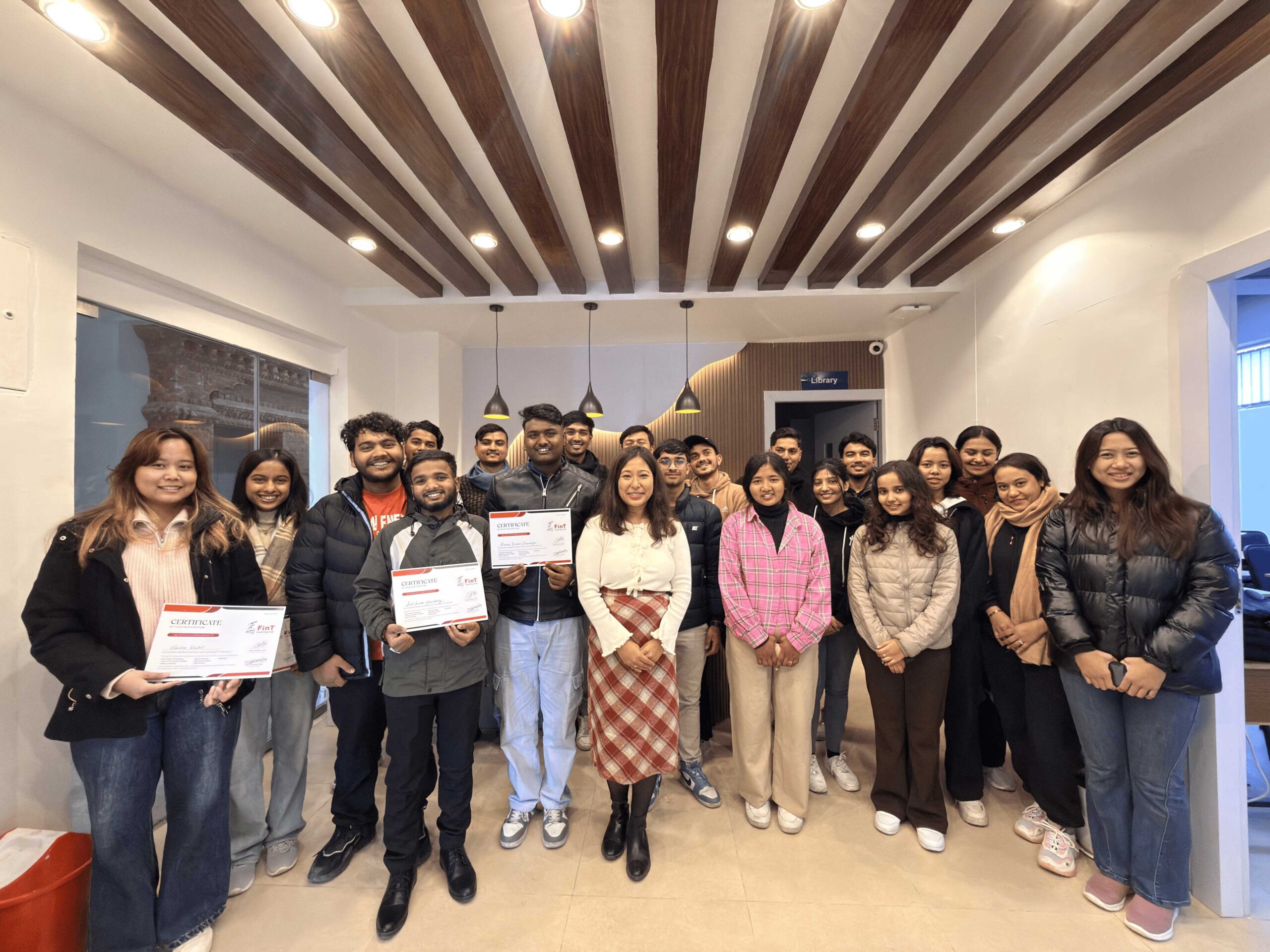
Audit Simulation Training Successfully Completed

FinT Learning Hub successfully conducted a 3-Day Audit Simulation Training, bringing together nearly 40 enthusiastic participants for an immersive, hands-on learning experience.

This special training was offered completely free of cost, reinforcing our commitment to practical skill development and industry exposure for aspiring accountants.

Trainer: Sriyesh Singh Thapa

The session was led by Sriyesh Singh Thapa, Founder of Lekha Sathi.

With strong practical insight into audit procedures and real-world financial review processes, he created a highly engaging and professional learning environment that simulated actual audit practice.

What the Training Included

Over the course of three intensive days, participants experienced:

  • Hands-on Audit Simulation
  • Review of Financial Documents
  • Identification of Errors and Misstatements
  • Preparation of Audit-Styled Reports
  • Team-based Work as Professional Auditors

Students were divided into teams and assigned audit responsibilities, allowing them to think, analyze, and report like real auditors. This collaborative approach enhanced analytical thinking, communication skills, and professional judgment.

Training Highlights

Active participation from all attendees
✔ Realistic and well-structured simulation environment
✔ Practical exposure beyond textbook theory
✔ Strong teamwork and professional engagement

The energy in the room reflected genuine curiosity and commitment to learning. Participants appreciated the opportunity to experience audit procedures in a structured yet dynamic setting.

More Than Just ACCA – We Make You Job Ready

At FinT, we believe accounting education must go beyond theory. Through software training, audit simulations, workshops, and practical exposure, we ensure our students are confident and workplace-ready.

If you want to gain practical skills alongside your professional qualification, join FinT today.

Contact Us

Phone: 9709103849
Email: info@fint.edu.np

Be part of a learning environment where we don’t just teach ACCA — we prepare you for real careers. Join FinT and build your future with confidence.

Xero Training – Batch 1 Successfully Completed

We are proud to announce the successful completion of Xero Training – Batch 1 at FinT Learning Hub!

The class commenced on 20 December 2025 and was delivered as an intensive 8-hour practical training program focused on real-world application of cloud accounting.

Trainer: Rejika Maharjan, FCCA

The session was conducted by Rejika Maharjan, FCCA, a Xero Certified Advisor who uses Xero daily in her professional work.

Rejika works as a remote accountant from Nepal, providing accounting and tax services to businesses in Australia and the USA. Her practical exposure ensured that students didn’t just learn the software — they understood how Xero is actually used in international accounting practice.

What Students Learned

This hands-on training covered:

  • Xero account setup
  • Chart of Accounts creation and customization
  • Sales and Invoicing process
  • Bills and Expenses recording
  • Bank Reconciliation
  • Fixed Asset management
  • Financial Reporting

Each topic was explained with practical examples so students could confidently use Xero in a real job environment.

Participant Feedback

We are delighted to share that Batch 1 received an average rating of 4.5 / 5 from participants.

The feedback highlighted:

  • Practical learning approach
  • Real-life case examples
  • Clear explanations

More Than Just ACCA

At FinT, we believe professional education is not only about passing exams — it’s about becoming job-ready.

That’s why:

  • Basic accounting software training is FREE for FinT students
  • Available at minimal charges for external participants

We don’t just teach ACCA. We prepare you for the workplace.

If you want to gain practical skills alongside your professional qualification, join FinT today and take the next step toward becoming a globally competent accountant.

Phone: 9709103849
Email: info@fint.edu.np

Join us and stay tuned