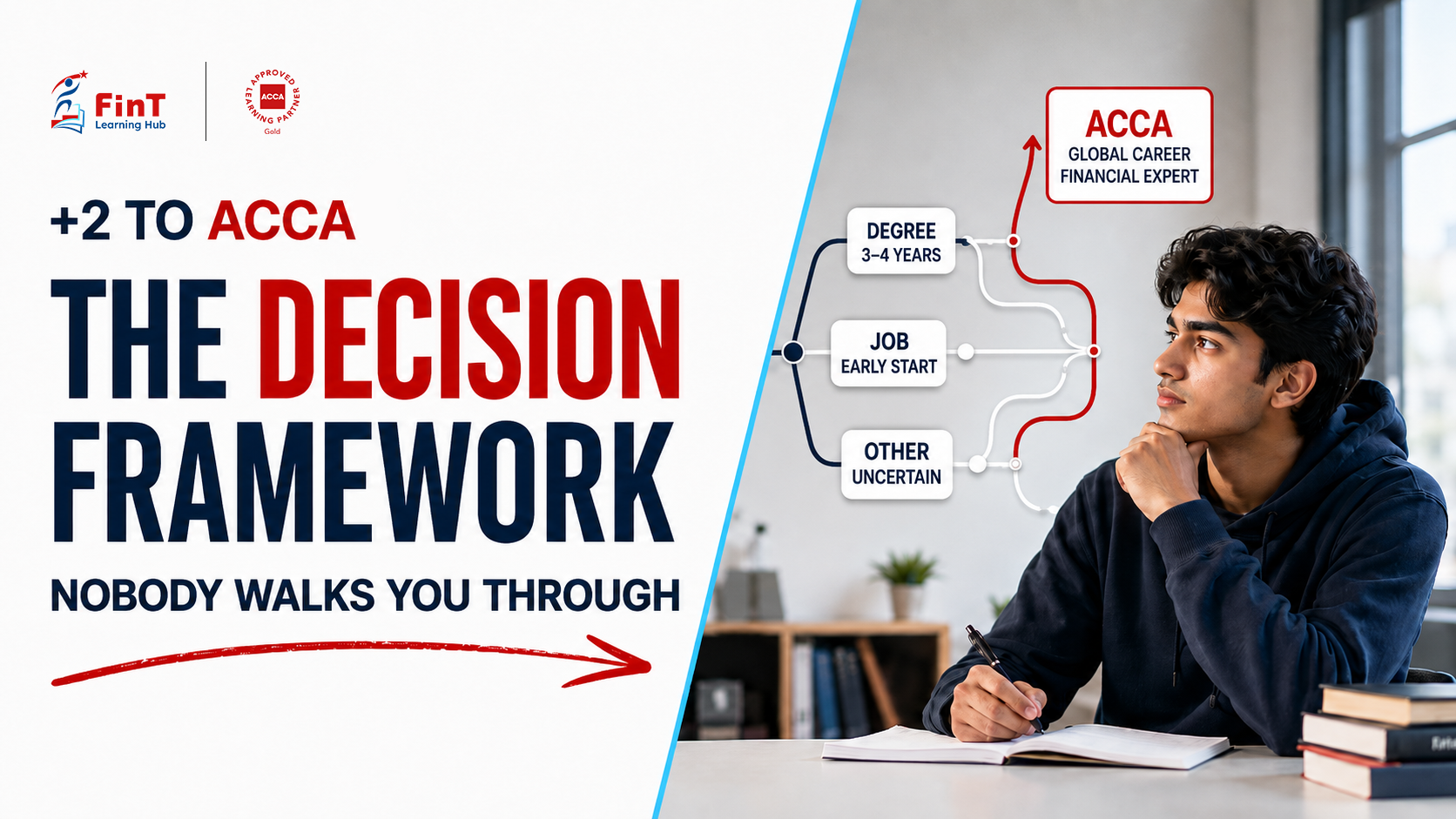
+2 to ACCA: The Decision Framework Nobody Walks You Through
July 22, 2026
Every year, thousands of +2 students in Nepal face the same choice: BBS, BBA, CA, or ACCA. Most blogs just say "follow your passion" or "ACCA opens global doors. "That's nice to hear, but it's not a decision. If you've just gotten your +2 results and you're trying to figure out what's next, you don't need another pep talk. You need a clear framework: what your stream really means for ACCA, what it costs compared to the alternatives, what the timeline actually looks like, and what your parents are probably worried about.
Step 1: What Your +2 Stream Actually Changes
A common myth is that only management students can do ACCA. That's not true. ACCA doesn't require a specific stream to get started.
- Management students usually have the smoothest start, since subjects like Accountancy, Economics, and Business Studies overlap with early ACCA papers (Business and Technology, Management Accounting, Financial Accounting).
- Science students aren't at any disadvantage in ability. Many do very well in ACCA's more analytical papers, like Financial Management and Audit. They just need extra time early on to get comfortable with accounting terms and business concepts that management students already know.
- Humanities students often underrate themselves. ACCA rewards clear thinking, good exam technique, and consistency far more than memorized commerce vocabulary skills strong humanities students already have.
The honest takeaway: your stream affects how comfortable you feel at the start, not whether you're eligible or how far you can go. What matters more is whether you're willing to put in steady, exam-focused effort from day one, no matter what you studied in +2.
One thing your background does affect directly is exemptions, but these are based on your bachelor's degree, not your +2 subjects. If you've already started a BBA, BBS, or B.Com alongside ACCA, check the official ACCA Exemptions Calculator before assuming you have to sit every paper: ACCA Exemptions Calculator
Step 2: The Real Cost Comparison
Most +2 students compare ACCA to BBA, BBS, or CA by asking, "Which one is cheaper?" That's the wrong first question. The better question is: cost per year of usable career outcome.
- BBS/BBA usually takes 3–4 years before you're ready for the job market, and many graduates go on to do ACCA or a master's afterward anyway to stay competitive.
- CA in Nepal is rigorous and well respected, but it typically takes longer to finish, and the pass rate at higher levels is lower, which quietly stretches out both time and cost.
- ACCA has 13 papers across 3 levels, usually completed in 30–36 months of focused study. Many students do it alongside a bachelor's degree, so your total time for two qualifications can end up shorter, not longer.
The comparison that actually matters isn't tuition fee versus tuition fee. It's: how many years until you're earning, and how much you're earning at each stage. Because ACCA is globally recognized, many students start working in finance, audit, or accounting roles while they're still clearing later papers, so the "cost" is partly something you fund as you go.
Read more: ACCA vs CA: Which Qualification Opens More Doors?
Step 3: What the Timeline Actually Looks Like
Here's a realistic month-by-month shape for a +2 graduate starting ACCA immediately:
| Phase | Papers | Typical Duration |
| Applied Knowledge | 3 papers | 6–9 months |
| Applied Skills | 6 papers | Next 12 to 18 months |
| Strategic Professional | 4 papers (2 compulsory + 2 optional) | Next 9 to 12 months |
| Ethics & Professional Skills Module (EPSM) | — | Alongside Strategic Professional |
| Practical Experience Requirement (PER) | 3 years, verified | Runs parallel to studies |
Notice that the 3 years of work experience isn't extra time tacked on at the end — it runs alongside your papers. That's why many ACCA students are already working in finance or audit roles before they've technically "graduated," something BBS/BBA students rarely get to do until after their degree is fully finished.
Step 4: The Conversation With Your Parents
If your parents aren't on board yet, here's what they're actually worried about even if it comes out as "But what about a normal degree?"
- "Is this internationally recognized, or just another private course?" ACCA is a globally governed qualification recognized in 180+ countries, with a set syllabus, external exams, and professional membership requirements. It's not a certificate made up by a single institute.
- "What if he/she doesn't finish it?" Because ACCA is modular 13 separate papers instead of one long program, partial completion still counts for something. Clearing even the Applied Knowledge and Skills levels shows employers real, verifiable competency, unlike an incomplete degree.
- "Will there be a job at the end of this course?" This is where practical experience (PER) matters more than people realize, because it means employment often starts during the qualification, not after it.
Step 5: Where FinT Fits Into This Decision
If you're leaning toward ACCA, the institute you choose changes the experience more than most students expect. At FinT Learning Hub, the focus is on keeping the path realistic, not just aspirational:
- Exam-focused classroom and online delivery, so you're not guessing what to prioritize across 13 papers.
- FinT Skills Lab, built around the practical, real-world skills employers actually ask for beyond just passing papers.
- FinT Placement support directly addresses the question, "Will there be a job?" instead of leaving it to chance.
- Commitment Scholarship and Gold Challenge, which exist specifically because cost and motivation are the two most common reasons students hesitate after +2.
Read more: What You Actually Learn at FinT: Inside the ACCA Course and the FinT Skills Lab
The Actual Decision
Don't choose ACCA because a blog told you to. Choose it if, after reading this, the honest answer to these three questions is yes:
- Am I comfortable with a paper-by-paper, disciplined study structure rather than one long fixed-length degree?
- Do I want work experience running alongside my qualification instead of after it?
- Does a globally portable credential matter more to me than a locally recognized one?
If that's a yes, the next useful step isn't more reading; it's checking your specific exemption status and talking to someone who can map out your 30–36 months, not a generic one.
Want a personalized breakdown based on your +2 stream and marks?
Reach out to FinT Learning Hub; the conversation costs nothing, and it's the one your parents will actually want to hear.